watchOS 10.1 Brings Double Tap to the Apple Watch Series 9 and Apple Watch Ultra 2

Apple recently released watchOS 10.1, with support for the much-ballyhooed double-tap gesture that selects the primary action in many apps without requiring that you touch the screen!

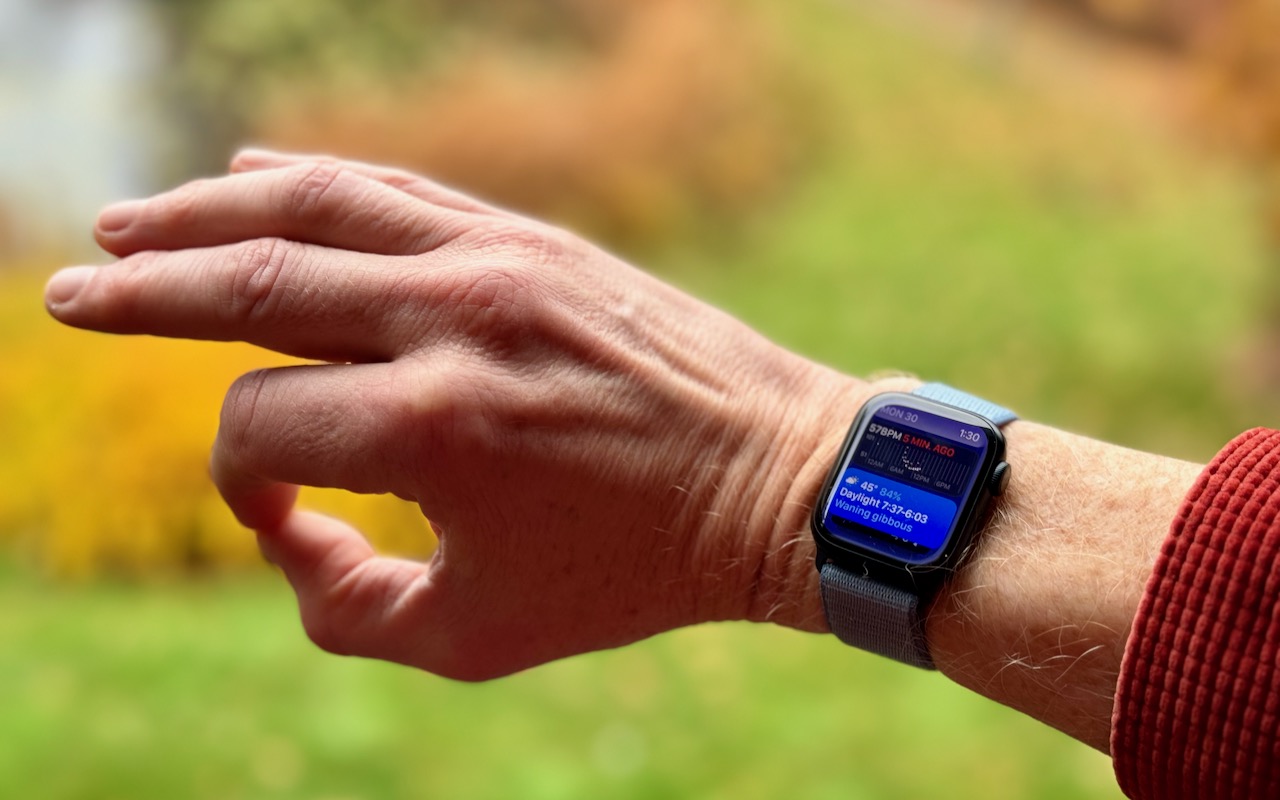
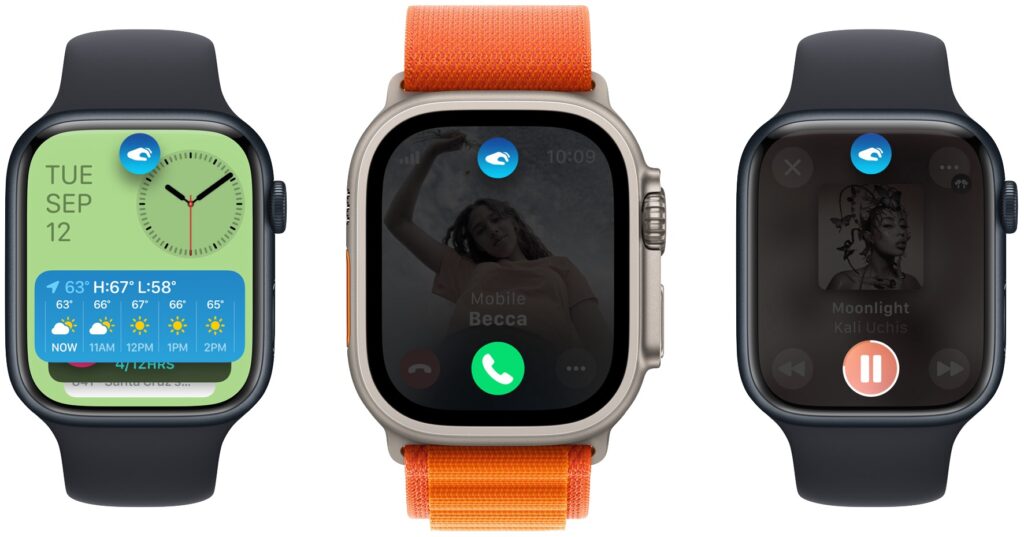
You might think that it is available only on the new Apple Watch Series 9 and Apple Watch Ultra 2, where you activate it by raising your wrist and tapping your thumb and index finger together twice, but I am gonna tell you how to activate it on your older Apple Watch, too.   For those with Apple Watch Series 9 or Ultra 2:  On the main Apple Watch screen, a double tap opens the Smart Stack of widgets you would otherwise get by turning the Digital Crown, and subsequent double taps advance through the widgets. A double tap also activates the primary action in many apps, such as answering and ending phone calls, playing and pausing media, viewing and scrolling through messages, ending timers, stopping and resuming the stopwatch, snoozing an alarm, responding to reminders from the Workout app, and performing the primary action from notifications. Whenever you double tap, you’ll see this icon at the top of the screen. If you have a supported Apple Watch model, give it a try!
 

To activate pretty much the same actions on your older Apple Watch you have to go to Settings > Accessibility > Quick Actions.
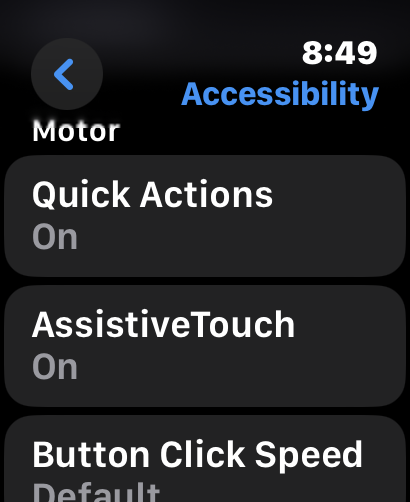
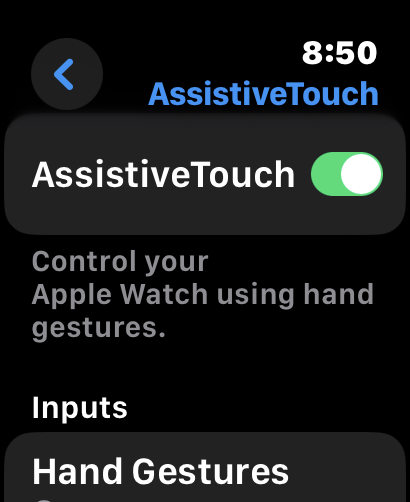
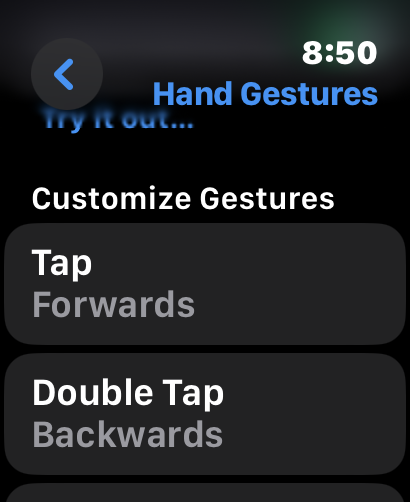
Switch AssistiveTouch on and then Customize actions by choosing Hand Gestures. The Quick Actions feature lets you tap your index and thumb together to dismiss a notification, snap a photo, or answer a call. When in an app or when a notification appears, the edge of the screen will go blue, and an alert will appear on the top that gives directions, like “Dismiss Double Pinch or “Double pinch to take photo.” AssistiveTouch adds more functionality. If you double-clench your fist, you’ll open the Action Menu. The Action Menu houses options for mimicking a Digital Crown press, a side button press, or opening Apple Pay.

You navigate the menu by moving through the list with a single pinch or backward with a double pinch. When you want to mimic a tap on the highlighted button, do a single fist clench. AssistiveTouch would allow you to go from the watch face to the Home Screen with apps, open an app, scroll through it and select further functions, open the app switcher, and move to a previously opened app. Compared to Double Tap on the Series 9 or Ultra 2, Quick Actions seems a bit  more limited but it is still very cool to tap your fingers together to dismiss an unwanted message or call.
Similar Posts

  • Spring Fever

    We’re all starting to chat the itch to spend some more time outside around the office. Most of us enjoy winter activities throughout the winter months, but we are coming out of one of the worst winters in a long time. There was little snow and many winter activities were cancelled over the past several months. To help get us out of the winter funk, we thought it was appropriate to celebrate “**Spring Fever**”:http://www.smalldog.com/springfever/spring-fever in our stores by putting together some great deals for accessories that you can use to enjoy the warmer weather that is upon us.

    Recently we have brought in products from several new manufacturers of speakers, headphones and iPhone accessories. One of my favorite new items that we have brought in are new “**Bluetooth speakers from Cambridge Audio**”:http://www.smalldog.com/product/87874/. These portable speakers come in a variety of colors, they easily sync to both your computer and iPhone (though not at the same time) and they have an auxiliary connection if you wish to plug the speaker directly into your device. We’ve all been impressed by the ease of pairing the speakers as well as the sound quality. These speakers normally sell for $99.99 but we have the titanium colored ones on sale for **79.99**. They are an excellent quality at this price point. Last week I introduced new Bluetooth headphones from “**BlueAnt**”:http://www.smalldog.com/category/?mmfg%5B0%5D=BlueAnt and we’ve decided to bundle these headphones with a **FREE** Belkin armband for iPhone 6/6s. We are really liking these new headphones! Check out these great “**Spring Fever deals**”:http://www.smalldog.com/springfever/spring-fever and more.

  • Black History Month – Thurgood Marshall

    Way before Barack Obama broke the color barrier to become president of the USA, Thurgood Marshall broke that barrier for another of the most powerful and important positions in the country, that of Supreme Court Justice. After graduating from high school with honors he applied to the University of Maryland law school where he was not accepted because he was black. Instead, he went to Howard University and received his law degree in 1933.

    Before being appointed Supreme Court Justice, he had a stellar career from 1934 to 1961 as a lawyer for the NAACP where he won landmark civil rights cases. Beginning in 1940, Marshall won 29 of 323 US Supreme Court cases. One of his first big cases was Smith vs. Allwrite in 1944 which overthrew the South’s “White Primary”. The White Primary was a practice of excluding African Americans from the Democratic Party. It was most common in a state where that party controlled the state government.

    In 1954 Marshall achieved a landmark victory with the case of Brown vs. Board of Education of Topeka. This Supreme Court decision demolished the legal basis for segregation in the USA. It also made state-enforced racial segregation in public schools invalid.

    In 1961 he was appointed the the US Court of Appeals by President Kennedy. He was the first African American on the Court of Appeals and went on to be appointed to the Second Court of Appeals. President Johnson made him the Solicitor General in 1965 and later in 1967 President Johnson nominated him for the Supreme Court.

    On the Supreme Court he was a steadfast supporter of positive gender and racial action policies and in his 24 years on the court he became a vocal liberal on a conservative-dominated court. He was an ardent supporter of Constitutional protection of individual rights, in particular the rights of criminal suspect versus the government. Marshall’s backing of Affirmative Action led to his strong dissent in the Regents of the University of California vs. Blake in 1978. Justice William Brennan was Marshall’s most reliable confederate who voted with him against the death penalty.

    Citing poor health, Thurgood Marshall stepped down from the court in 1991 and remained a vocal critic of the court until his death in 1993 at the age of 84.