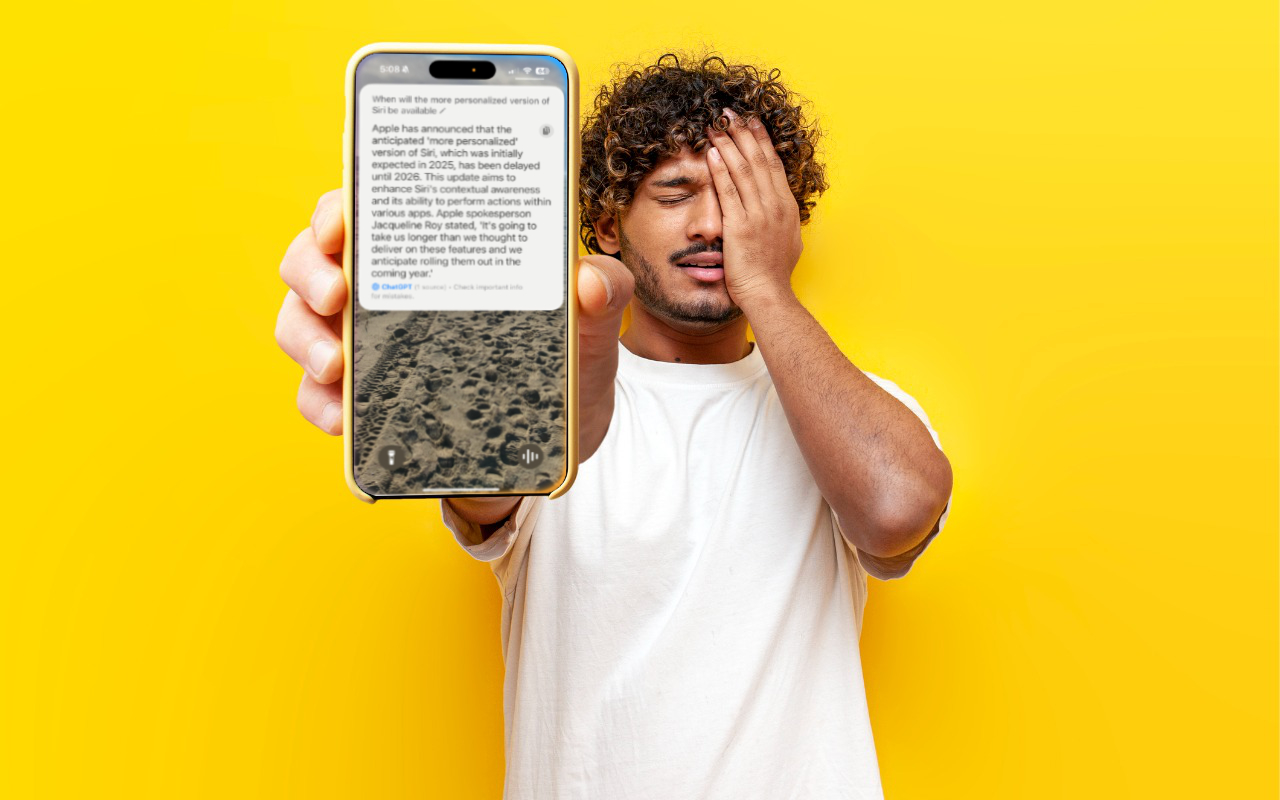
Apple Says More Personalized Siri Will Be Delayed

As we’ve been covering Apple’s staged rollout of Apple Intelligence, one announced feature that has remained tantalizingly in the future is the enhanced version of Siri that would have onscreen awareness, understand your personal context, and be able to interact with apps. The company has quietly admitted that this new version of Siri isn’t ready yet and now says it anticipates rolling it out in the coming year. That probably means in conjunction with some version of iOS 19 and macOS 16, expected to debut in September 2025 and receive updates through early 2026. In short, don’t expect this new Siri anytime soon. We’d prefer to see Apple get Siri to succeed at all the tasks it’s supposed to handle now—too many of the things we try to do with Siri fail.

(Featured image based on an original by iStock.com/Bogdan Malizkiy)


Social Media: If, like us, you’ve been eager to try the Apple Intelligence-enhanced version of Siri that Apple announced at its Worldwide Developer Conference in 2024, we’re sorry to say that we all have longer to wait.

Similar Posts

  • _Dear Friends,_

    New data from Piper Jaffray’s teen survey show that Apple is dominating that market at least as far as mobile devices are concerned. They have 71% of the teen market for smart watches and almost 70% for iPhones and 64% for iPad. Another survey has Apple Mac sales showing positive growth while literally the entire PC market is in decline.

    I have been playing around with Amazon’s Echo and I have to say that I like it a lot. I wake up each morning and say “Alexa, what’s new?” and I get the news reports from NPR, CNN, Huffington Post and BBC as well as ESPN Sports and the local weather report. During the day, I ask Alexa to “play the blues” or “play some classical music” and while the speaker is not as good as my Sonos system it does fill the room. I can be around the corner or across the room and the Echo can hear me. Apple needs to step it up a bit and get Siri on the Mac or even better yet, integrated into their networking gear. I would love to be able to tell my Sonos app to play my music from my iTunes library!

    Speaking of networking here’s a Kibbles & Bytes exclusive! This isn’t for everyone but if you have a big house and your Wi-Fi signal isn’t reaching that far corner of the house this could solve three problems for you! I am bundling the Apple Factory Refurbished 3TB Time Capsule with an Apple Factory Refurbished Airport Express. Both have the same 1-year Apple warranty as new but you can save some bucks. The 3TB Time Capsule gives you the Airport Extreme wireless access point and automatic wireless back-ups to the integrated 3 terabyte drive. The Airport Express allows you to extend that wireless network. Normally “**this bundle**”:http://www.smalldog.com/wag900002195/extend-your-network-and-back-up-your-data-for-only-325-99? is around $500 new, but this week for Kibbles & Bytes readers, while supplies last you can buy this refurbished bundle for only “**$325.99!**”:http://www.smalldog.com/wag900002195/extend-your-network-and-back-up-your-data-for-only-325-99?

  • Who cares about QR Codes?

    By now you’ve probably seen one of those odd-looking white squares with a bunch of smaller square dots that make up a random pattern inside–that’s a QR code. QR stands for “Quick Response,” and a QR code is a form of barcode, just like on the packaging of nearly everything you buy.

    Usually QR codes are used to store Web links–URLs–so an ad can display just the QR code instead an unwieldy and hard-to-type web address. But QR codes aren’t just for ads. They’ve appeared on business cards, in magazines and books, on coins and bills, and even on tombstones–any place it would be nice to help someone load a Web link into a smartphone but where there isn’t enough room for a URL or in situations where viewers won’t remember the URL later. And the links? They can display anything that can appear on the Web: text, photos, videos, games, and more.

    Only one built-in iPhone app can scan QR codes–the Wallet app in iOS 9–but it can scan only QR codes that are associated with Wallet passes, things like airline boarding passes, concert tickets, and iTunes gift cards. For QR codes that encode any other sort of data, Wallet shows an error. It would be nice if Apple would add general QR scanning capabilities to Wallet or the Camera app, but until that happens, you’ll need another app.
    There are numerous QR code scanning apps in the App Store, but if you need a recommendation, give TapMedia’s QR Reader for iPhone a try. It’s free with ads (remove them with a $1.99 in-app purchase), scans both QR codes and traditional barcodes on most commercial products, and displays the associated information within the app. It can even help you create your own QR codes.

    To use a QR code scanner, launch the app, allow it to access the camera when it asks, and then point it at the QR code. Good apps will scan nearly instantly, but if not, move the camera so the QR code is centered between the guides. If even that doesn’t work, move forward or back so the camera can focus on the centered code.

    Once the code has been scanned, the app will usually bring up an in-app Web browser to display whatever was encoded. For certain kinds of data, like books or grocery items, the app may go right to Amazon or a price comparison site. Good apps will also keep a record of sites you’ve scanned, so you can go back to them later, even if you can no longer scan the QR code.

    So download a QR code scanning app and keep an eye out for QR codes. Once you start looking, you’ll find them everywhere–it’s a modern-day treasure hunt!