Notable User Interface Changes to Expect in macOS 26

macOS 26 Tahoe is a larger visual leap than any recent upgrade. Although we don’t yet recommend that everyone upgrade, we want to show you some of the user interface changes that will impact your everyday experience of using the Mac.

Liquid Glass Changes

Many of these changes stem from Apple’s new Liquid Glass design language, which we’ve previously covered in more detail. Familiar macOS interface elements with a new Liquid Glass appearance include:

  • Rounded corners: You may be surprised by the more rounded corners in many interface elements, including windows. There’s no option to adjust the corner radius.
  • Menu bar: Tahoe’s menu bar is now transparent, allowing app windows or desktop wallpapers to show through, which can make it less visually prominent at the top of the screen. To make it opaque, go to System Settings > Accessibility > Display > Reduce Transparency. This setting also affects many other transparent interface elements.
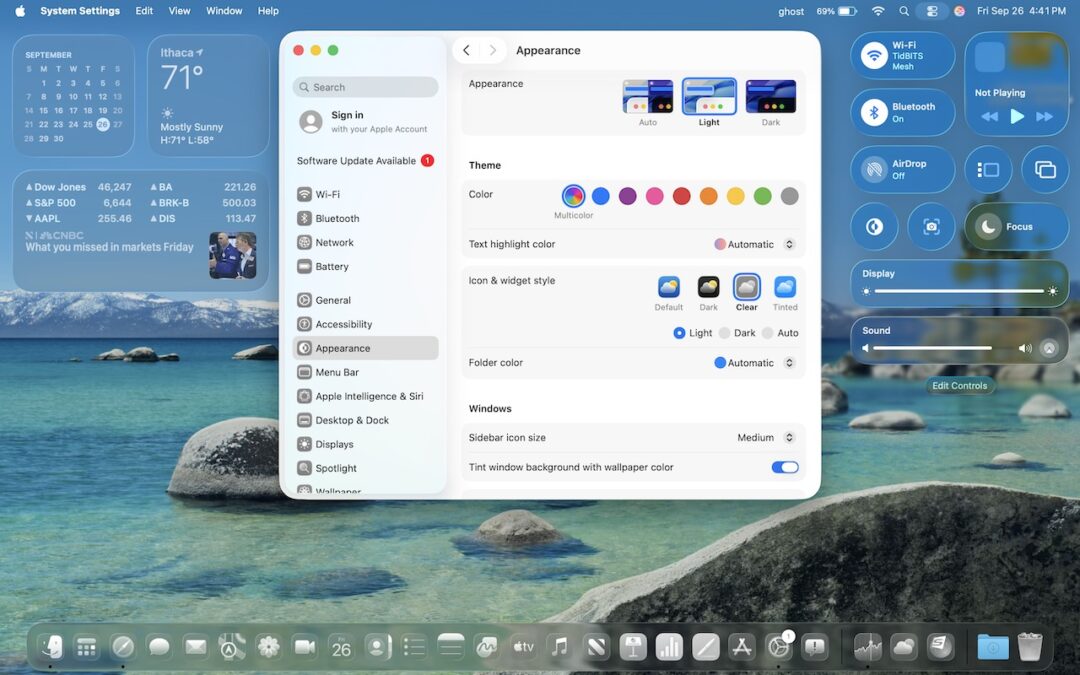
  • Icon style: Many developers are updating their icons to conform to Apple’s Liquid Glass guidelines. A more notable change is that users can now switch to dark mode icons, clear icons, or tinted icons in any color. Make these changes in System Settings > Appearance > Icon & Widget Style.
  • Widget style: Desktop widgets are now mostly transparent when any window is open on the desktop, and they become solid only when the last window is closed or hidden. You can adjust this setting in System Settings > Desktop & Dock > Dim widgets on desktop. Widgets also adopt the same clear or tinted style used by icons.
  • Customized folders: Folders start out blank, but you can Control-click one, choose Customize Folder, and pick an icon (monochrome) or emoji (colored) to brand the folder.
  • Sidebars: Although they’re less transparent than other items, sidebars become subtly tinted based on what’s under them. That occasionally results in some awkward overlays, such as in System Settings > Wallpaper, where the thumbnails can scroll underneath the sidebar.

Safari

With Safari, Apple’s Liquid Glass interface causes the toolbar controls and the tab bar at the top to float over the page content underneath. On some sites, this can be distracting or make tab titles hard to read (below, top). If that bothers you, turning on System Settings > Accessibility > Display > Reduce Transparency separates the controls from the content more clearly, but also gives them a gray background (below, bottom).

Control Center

In Tahoe, Control Center not only receives a Liquid Glass makeover but also gains notable new features. Similar to iOS and iPadOS, you can now fully customize the buttons, sliders, and other interface shortcuts in Control Center, removing those you don’t need and adding others. To get started with personalization, click Edit Controls at the bottom of Control Center.

The selection of commands is impressive enough on its own, but Apple also promises that independent developers will be able to offer controls for their apps. Clicking the + button in the menu bar provides the equivalent of additional Control Center pages from iOS: another menu bar icon that displays a different set of Control Center items. You can have as many of these extra Control Center pages as you want.

Lastly, note that you can add many items from Control Center directly to the menu bar, where they can function as toggles or quick access shortcuts.

Spotlight

Apple revamped Spotlight in Tahoe, adjusting its interface (yes, it’s transparent by default, too) and introducing clipboard history. When you activate Spotlight with Command-Space and move the pointer, four buttons appear to filter your search by apps, files, shortcut actions, and clipboard history—Command-1 through 4 serve the same purpose.

Previously, Spotlight separated different result types vertically; now you can click buttons just below the search box to filter results by category. Spotlight also remembers past searches, allowing you to use the arrow keys to browse backward and forward through your search history.

Spotlight’s new Apps view, which gets its own icon on the Dock, also replaces the longstanding but little-used Launchpad. If you want a full-screen grid of app icons, similar to Launchpad, consider Launchie, AppHub, or AppGrid Launcher.

Terminal

Although many people never open the Terminal app, which gives access to the Unix command line hidden in macOS, Apple has finally updated it to allow for more customization. Fortunately, Terminal still features completely opaque windows—transparency won’t make reading command-line output any easier. Each profile offers various customization options beyond appearance, so those who frequently use Terminal can tailor it to their preferences.

While we don’t want to downplay the impact these visual changes may have on your Mac experience, we’ve also found they’re easy to get used to or turn off. After using Tahoe for a few weeks, most of these changes will become the new normal. Apple will undoubtedly continue to polish Liquid Glass over the next year, refining its smoothness and eliminating awkward bits.

(Featured image by Apple)


Social Media: From transparent menu bars to customized folders, macOS 26 Tahoe introduces the most significant visual update in years. Discover the key interface changes that will influence your daily Mac use… and which you can turn off.

Similar Posts

  • Missed an Alert? Check Notification Center

    iOS, iPadOS, and macOS all let you specify whether any given app should show no notifications, temporary banners, or persistent alerts: look in…

  • The Most Profit Ever in a Single Quarter

    Apple posted record earnings and profit for the holiday quarter disappointing those analysts that predicted less than stellar results. Of course, the realistic guidance for the next quarter sent Apple stock plummeting while those same analysts maintain a price target that is $40-50 higher than the current price of the stock. Okay, so Apple’s profit and revenue were all time records for the company but the remarkable tidbit is that no public corporation ever has posted that much profit in a single quarter. Let’s see how Apple did that.

    First of all, Apple sold 74.8 million iPhones in the quarter. Not too shabby and that revenue is nearly 70% of Apple’s total. The average sales price (ASP) for the iPhone was up to $691 which also led to slightly higher gross margin. To put that is some perspective that is an average of 34,000 iPhones sold per hour 24/7 for 13 weeks.

    They finished the quarter with about $215 billion in cash which represents about $39/share. Macs sales were down a bit at 5.3 million units and the iPad continues to do moderate in sales with sales dropping year on year from 21.4 million units to 16.1 million units.

    Currency “headwinds” have caused some of these results to be muted. With the exceptionally strong dollar it is more difficult to export US goods and sales suffer a bit. The Euro and British Pound were down double digits and the Canadian and Australian dollars were down 20% or more. It gets worse. The Russian Ruble is down by 50% and Brazilian Real is down 40%. Apple estimated that if it were not for these global currency fluctuations that their revenue would have been over $80 billion representing an 8% increase. But despite those headwinds, Apple posted their best quarter ever.

    Other high points were service revenue which was the highest ever at over $6 billion. Wow, $6 billion in just iTunes, App store and a few other things. That is more revenue that quite a few well known companies and a 24% growth year over year. Other products which include the Apple TV, Beats and Apple Watch also were strong with $4.5 Billion in sales.

    In another milestone that just points to the success of the services side of Apple’s business Tim Cook announced that they now calculate that there are more than 1 billion Apple devices in use worldwide which is up 25% year over year. That is simply incredible considering that there are only 7.4 billion people on the planet!

    What sent Apple stock down was Apple’s realistic prediction that iPhones sales in their 2nd fiscal quarter would decline year over year by as much as 15-20%. Last year’s 2nd quarter was strong because of supply issues that moved some revenue from the 1st to 2nd quarter and the impact of the global currency situation has caused some price adjustments. Apple remains very bullish on the iPhone market and pointed to the fact that in China over 50% of the iPhones sold were to people buying their first iPhone. Apple pointed out that the growth of the middle class in China is unprecedented with the middle class comprising about 50 million people in 2010 and now it is projected to be $500,000,000 by 2020.

    Even if Apple sells “only” the 40-45 million iPhones in this quarter that would still be more revenue that most companies earn overall in a single quarter. To put this in perspective, Apple books more revenue at strong margins, than Amazon, Facebook, Google or Microsoft generate from all of their operations.

    All in all the financial results that Apple announced were an incredible testament to the quality and innovation of Apple products and of a company doing things right. Congratulations to the entire Apple team!

  • Audit How You Appear in Google Search

    Google has created a free service that lets you see what of your personal and professional information has been published on the Web….

  • Keyboard Shortcuts

    I got my start in using computers with CPM operating system and keyboard shortcuts were present there. I used them all the time so they come as second nature to me. But as I go out and talk with customers and help them with their Macs, I am surprised by the number of people that do not know that most of the things you can do with your mouse by clicking on a menu item can be done faster with keyboard shortcuts.

    The first thing to learn about shortcuts are the symbols that are used to show these keys.

    Command ⌘
    Shift ⇧
    Option ⌥
    Control ⌃
    Caps Lock ⇪
    Fn

    These work for your Mac Keyboard but if you are using a keyboard made for a Windows machine you need to substitute the Windows logo for the Command key and the Alt key for the option key. When you look at a menu in almost any application you will find the common commands for all these symbols next to them to indicate the keyboard shortcut. Here are some common ones:

    Command-X **Cut** Remove the selected item
    Command-C **Copy** the selected item
    Command-V **Paste** the contents
    Command-Z **Undo** the previous command
    Command-A **Select all** items
    Command-F **Find** open a Find window
    Command-G **Find Again** Find the next occurrence of the item previously found
    Command-H **Hide** the windows of the front app.
    Command-M **Minimize** the front window to the dock
    Command-M **New** Open a new document or window
    Command-P **Print** the current document

    Command-Space bar **Spotlight** show or hide the spotlight search field
    Command-Tab **Switch apps** switch to the next most recently used app
    Command-shift-3 **Screenshot** take a screenshot of the entire screen

    As you can see, there are endless keyboard shortcuts to use, and these are only a small fraction of what you can do with “**keyboard shortcuts.**”:https://support.apple.com/en-us/HT201236 So the next time you find yourself wondering what you can do if your mouse suddenly stops working or if your just looking for a more efficient way to do something, keyboard shortcuts might just be what your looking for!