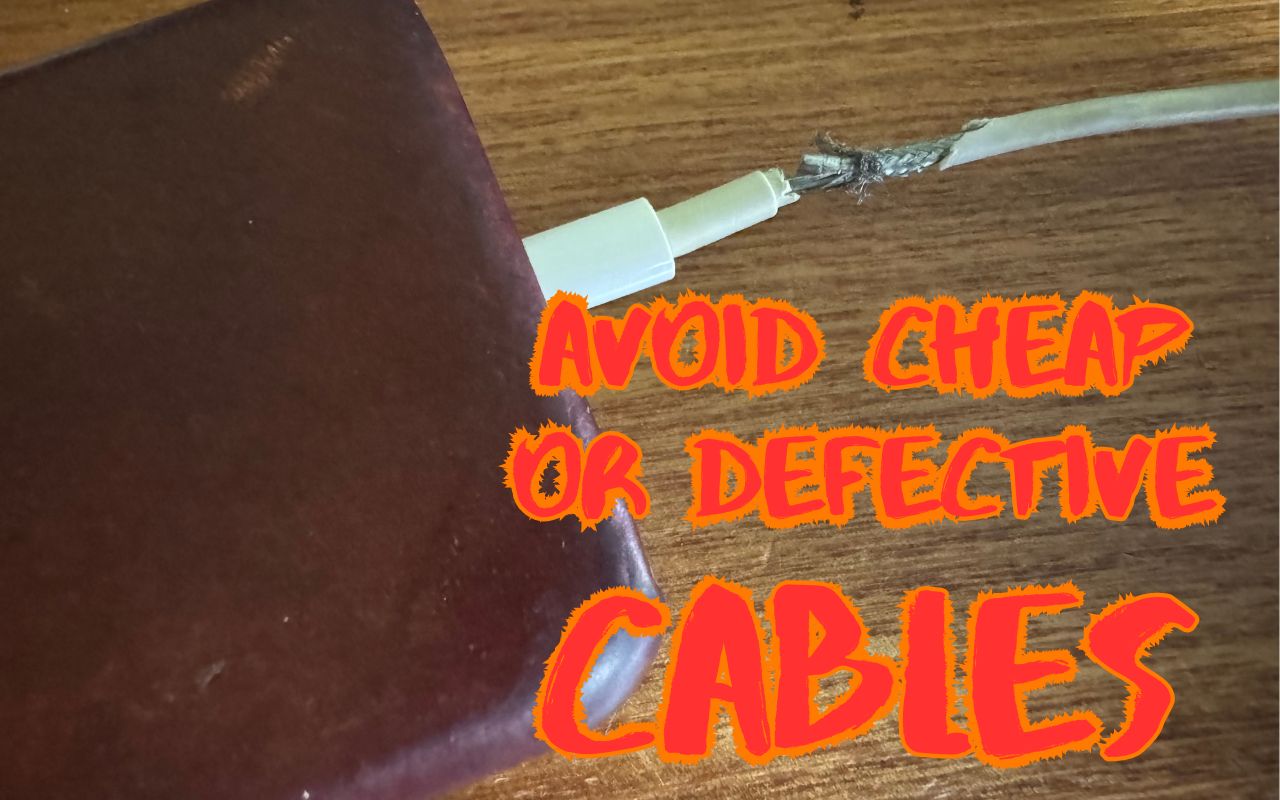
Use High-Quality Cables for Optimal Performance and Safety

Apple’s prices for Thunderbolt, USB-C, and Lightning cables often seem unnecessarily high. $69 for a Thunderbolt 4 cable or $19 for a simple USB-C to Lightning cable? Unfortunately, when it comes to cables, you often get what you pay for. Happily, other reputable hardware manufacturers sell quality cables for less than Apple. When possible, get cables with braided covers, which tend to last longer because the braided design makes them less prone to kinks, less likely to tangle, and more resistant to abrasion.

Stay away from bargain-priced cables from no-name Chinese manufacturers, and if you see a supposedly genuine Apple cable selling for a too-good-to-be-true price, consider the possibility that it’s counterfeit. Apple created a detailed page that explains how to identify counterfeit or uncertified Lightning accessories.

Why spend more on cables? Inexpensive cables are likely to wear out sooner, but the main concern is that many modern cables carry power along with data. A short circuit could result in hardware damage and, in extreme cases, could generate sparks, smoke, or even fire. While fires are extremely unusual, it’s easy to find reports online.

When it comes to damaging hardware, USB-C is much less of a problem than a decade ago, thanks to Google engineer Benson Leung. After a bad USB-C cable fried his Chromebook, he embarked on a one-man crusade to identify good and bad USB-C cables. Due in part to his efforts, Amazon started prohibiting listings of USB-C cables and adapters that weren’t compliant with the USB-C specs. You may still encounter bad cables Amazon hasn’t identified or dodgy cables sold through other retailers, but the danger is lower than it used to be, particularly with cables from name brands.

Although Apple has now standardized on USB-C cables for charging, Lightning cables remain common for older iPhones and iPads. Both are readily available in gas stations and drugstores, but you’ll do best if you stick with cables from brand-name companies. They cost more, but do you trust a cable sold next to tabloids and Twinkies? It will probably work in a pinch if you need to fill in for a lost or forgotten cable on a trip, but don’t rely on it afterward.

Even the best cables will fail if you mistreat them. Follow this advice to ensure a long life for heavily used cables:

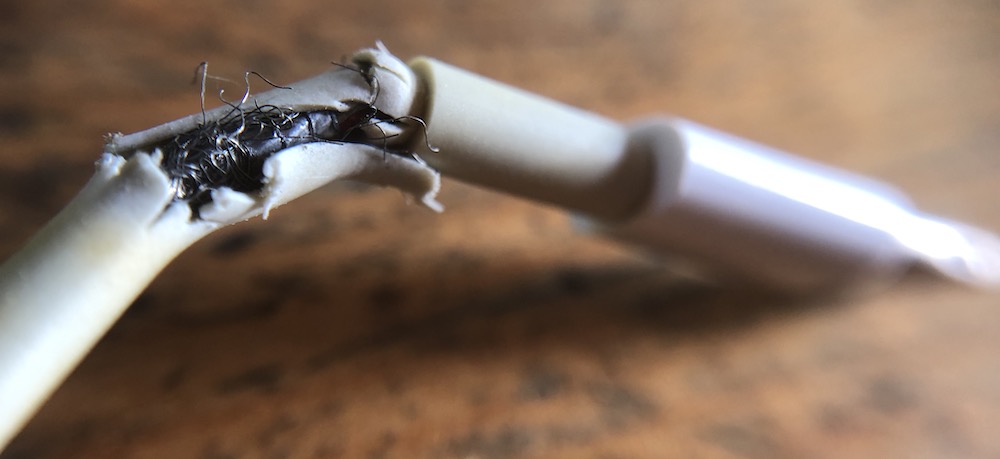
  • Don’t create sharp bends in the cable, especially near the connector. Sharp bends can eventually break the insulation and reveal the wires inside. Even before that, if the wires get too close, they can heat up and melt the insulation.
  • When unplugging your device, pull from the plug instead of farther down on the cord to avoid stress on the connection point.
  • When coiling your cables, avoid wrapping them tightly around something that’s not round. A tight wrap can cause kinks that degrade the wires inside.
  • Don’t put heavy objects on cables or sandwich them between a desk and the wall. Anything that compresses the cable can cause damage.
  • iPhones are fairly water resistant, but try to keep the charging port and cable plug clean and away from liquids. Pocket crud or a droplet in the wrong place could cause a short circuit. Because of their metal jackets, USB-C cables are less susceptible than Lightning to such problems, but it’s still worth being careful.
  • If a cable’s insulation ever breaks so you can see the wires inside, discard it immediately. It’s always worth maintaining a collection of a few cables of every type you use so you can replace damaged cables right away.
In the end, the advice is simple. Spend a little more on quality products from reputable manufacturers so you don’t have to worry about a $3 non-compliant USB-C cable damaging your pricey iPhone or worse. What’s worse? Your house burning down.

(Featured image by Adam Engst)


Social Media: It’s tempting to buy cheap USB-C and Lightning cables, but non-compliant, counterfeit, and defective cables can damage your hardware or even cause fires. Read on for more about keeping your cables working in the long run.
Similar Posts

  • Advice for Good Office Ergonomics

    Let’s look at how to keep your body comfortable and healthy when you interact physically with your Mac. In a word: ergonomics. You’ll…

  • The Little Guy(s)

    You know I am a rabid Boston Celtics fan, and I have been since I was a child listening to games on my transistor radio, searching for the gravely voice of Johnny Most. These days our All-Star and team leader is Isiah Thomas who NBA hall of famer, Tommy Heinsohn, always refers to as the “little guy”. We have been thinking of changing our dog, Max’s name to the little guy as a result.

    It was little iPhone and little iPad Pro day at the Apple event. Apple introduced the 4-inch iPhone SE and the iPad Pro 9.7-inch tablet. In other hardware announcements, there were new watch bands for the Apple Watch and a new Lightning to USB 3 camera adapter. The original iPad Air is now discontinued and the iPad Air 2 with a more limited selection becomes the entry-level 9.7-inch iPad.

    I have gotten used to the size of my iPhone 6 but there are many people that want a smaller iPhone. Having a big iPhone 6 or 6+ sticking out of your back pocket is an invitation to theft and they do get a big bulky in the front pocket of your jeans. The iPhone SE uses the iPhone 5 form factor, with a 4-inch screen and aluminum case. The iPhone SE is not crimping on power though, as it meets almost all of the specifications of the iPhone 6s. It fails to match up to the current iPhone lineup only in the lack of the 3D Touch technology, the Taptic Engine that provides feedback you can feel, and slower wireless networking. It’s either $399 or $499, with 16 GB or 64 GB of storage, and comes in the same four colors, Silver, Space Gray, Gold and Rose Gold. We have found that most cases for the iPhone 5 should work with the iPhone SE. These are shipping on March 31.

    p{text-align: center;}. !http://blog.smalldog.com/images/4692.png!

    The 12.9-inch iPad Pro, introduced last year with the Apple Pencil and Smart Keyboard, has enjoyed some moderate acceptance as a productivity device. I can see how for some, it might be their only device. And for artists, architects and others the iPad Pro is a digital drawing board like no other. But it is 12.9 inches and that is just a bit large for some. Apple introduced the 9.7-inch iPad Pro to meet this need, which meets or exceeds many of the larger model’s specs.

    For instance, the smaller model’s screen can display more colors and adjusts its white balance to match the ambient light in the room. Its cameras are notably better — the rear camera is 12 megapixels instead of 8 and has a True Tone flash, while the front camera is 5 megapixels instead of 1.2 and can use the screen as a flash. Plus, the new iPad Pro can record 4K video instead of just 1080p. I assume we will see these upgrades to the 12.9 inch iPad Pro in the future but the smaller version is a powerhouse.

    The 9.7-inch iPad Pro’s A9X chip is somewhat slower, it has half the RAM, and its Lightning port transfers data at only USB 2 speeds. But if the size is right for you, prices start at $599 for 32 GB of storage and go up to $899 for 256 GB. It will be shipping on March 31 in four colors: silver, gold, space gray, and rose gold. Cases and accessories designed to fit the iPad Air 2 should work with the 9.7-inch iPad Pro. We have our orders in with Apple and should have stock by the launch date. I think this new iPad Pro is going to be the iPad of choice for a lot of people.

    p{text-align: center;}. !http://blog.smalldog.com/images/4689.png!

    Apple also introduced the $39 Lightning to USB3 camera adapter. It is much more than a camera adapter though and opens the Lightning port to a lot of USB devices. With the Lightning to USB 3 Camera Adapter, it’s easy to transfer photos and videos from your high-resolution digital camera to your iPad Pro.
    If you connect with a USB Power Adapter, you can connect USB peripherals like hubs, ethernet adapters, audio/MIDI interfaces, and card readers for CompactFlash, SD, microSD, and more. This is a new and important step by Apple in making the Lightning port much more versatile.